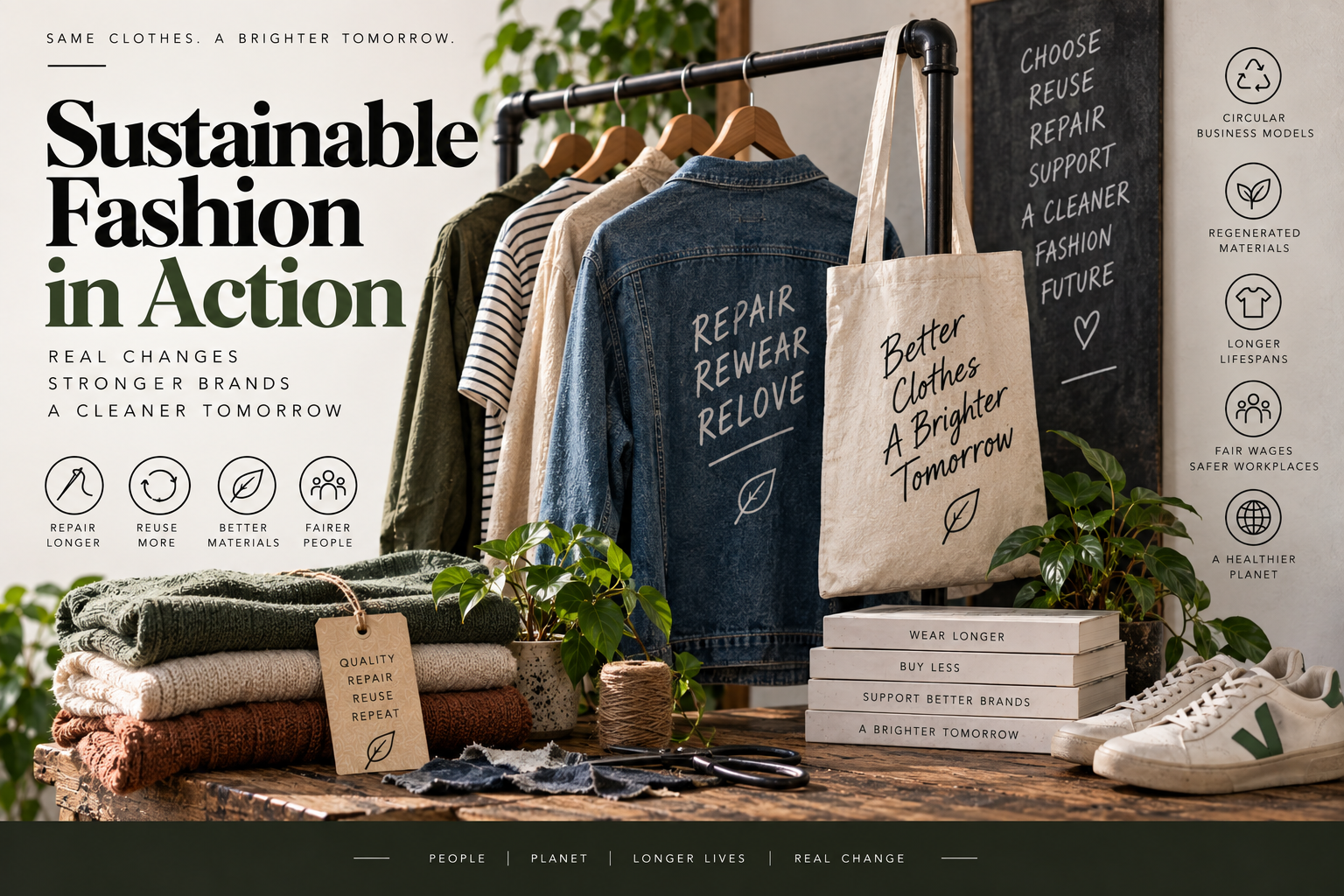
The useful question is not which brand is greenest. It’s what each one has actually changed about how clothes get made, sold, and kept in use.
Certification tells you a company passed an inspection. That matters, but it’s a floor. The brands below are interesting because they’ve altered something structural — the repair economics, the ownership model, the material input, or the amount they’re willing to tell you. Each is followed by the honest limitation, because none of these fix the underlying problem on their own.
Brands making repair the default
The single biggest lever in fashion’s footprint is how long a garment stays in use. A few brands have built their business around that rather than treating it as a marketing add-on.
Nudie Jeans offers free repairs for life on its denim, regardless of when you bought it, alongside repair shops, pop-up mending events, and free repair kits by post. The Swedish brand works in GOTS-certified organic cotton and uses a dyeing process that reduces water consumption compared with conventional indigo methods.
Patagonia pairs its repair guarantee with a straightforward message to buy less. A worn jacket gets fixed rather than replaced, and the company has spent years arguing publicly against unnecessary consumption — an unusual position for a business that sells things.
The limitation: repair programmes only reach customers who use them. Most people don’t. The offer is meaningful; the uptake is the variable.
Brands buying their own clothes back
Resale run by the brand itself closes a loop that third-party platforms leave open.
Patagonia’s Worn Wear resells used gear directly. Eileen Fisher’s Renew takes back returned garments to resell or repurpose — a natural fit for a label built on minimalist pieces designed to stay wearable for a decade. Nudie’s Re-Use programme collects worn jeans, repairs them, and sells them on as one-off pieces, with a discount for customers who hand theirs in.
The limitation: take-back schemes can quietly justify higher production volumes. The test is whether a brand publishes what it actually collects and what happens to it, rather than announcing the programme and going quiet.
Brands rethinking ownership entirely
MUD Jeans is the clearest example. The Dutch label runs a leasing model — you pay monthly, then keep, swap, or return the jeans for recycling into new pairs. Its take-back scheme accepts denim from any brand, not just its own, provided the cotton content is high enough to recycle. The company builds fabric from post-consumer denim through a partner facility in Spain, working toward fully recycled jeans.
The limitation: leasing suits denim because jeans are durable, standardised, and recyclable. It doesn’t obviously extend to most other categories.
Brands changing the material itself
ARMEDANGELS carries one of the broadest certification stacks in European fashion — GOTS across its organic cotton and wool lines, plus GRS for recycled fibres, OCS, Fair Wear Foundation membership and Fairtrade. What makes it notable is breadth: the certification covers product categories generally, rather than a single “conscious” collection sitting beside a conventional range.
Girlfriend Collective builds activewear from recycled inputs with sizing from XS to 6XL. Performance fabrics are synthetic almost by definition, so recycled content is the pragmatic answer rather than a clean one.
The limitation: recycled polyester still sheds microfibres in the wash, and recycled content says nothing about labour conditions. Look for GRS or OCS alongside a social standard, not instead of one.
Brands competing on transparency
The most underrated shift is disclosure. MATE the Label publishes its factory partners while holding GOTS and B Corp certification. ASKET built its whole proposition on a permanent collection with no seasons and detailed cost and origin information per garment.
This is where smaller independent sustainable labels often outperform large groups. A brand with a handful of suppliers can name them. A conglomerate with thousands cannot, and usually doesn’t try. Fashion Revolution’s annual Transparency Index tracks how much major companies actually disclose, and the numbers stay consistently below what the advertising implies.
The limitation: transparency is not the same as good practice. A published supplier list makes a brand auditable, not automatically ethical. It just removes the excuse.
What actually moves the needle
Being honest about scale: repair programmes, resale schemes and recycled inputs are real improvements operating at the margins of an industry built on volume. A brand that repairs ten thousand jeans while the sector sells billions of new garments has done something good and not something decisive.
Two shifts matter more than any individual company. The first is regulation — EU rules taking effect this September restrict unsubstantiated environmental claims, and a forced labour ban covering the EU market follows in December 2027. The second is total consumption. No production improvement compensates for buying more.
Which is why the most effective thing on this page isn’t a brand name. It’s wearing what you already own for longer.
How to choose between them
Match the brand to the category. Nudie or MUD for denim, Patagonia for outerwear, ARMEDANGELS or MATE for everyday cotton, Girlfriend Collective for activewear. No single label covers a wardrobe well.
Prioritise your highest-rotation pieces. Certified quality earns its cost per wear on the items you reach for constantly. Long-lasting wardrobe staples justify their price over years; trend pieces never will.
Use the repair and resale programmes. They only count if you actually send the jacket back.
Buy secondhand for everything else, and time the larger purchases — picking up certified staples during a seasonal offer narrows the price gap without lowering the standard.
Verify before you commit. Certifications lapse and ownership changes. A GOTS logo is an image; a GOTS licence is a searchable record. Check it.